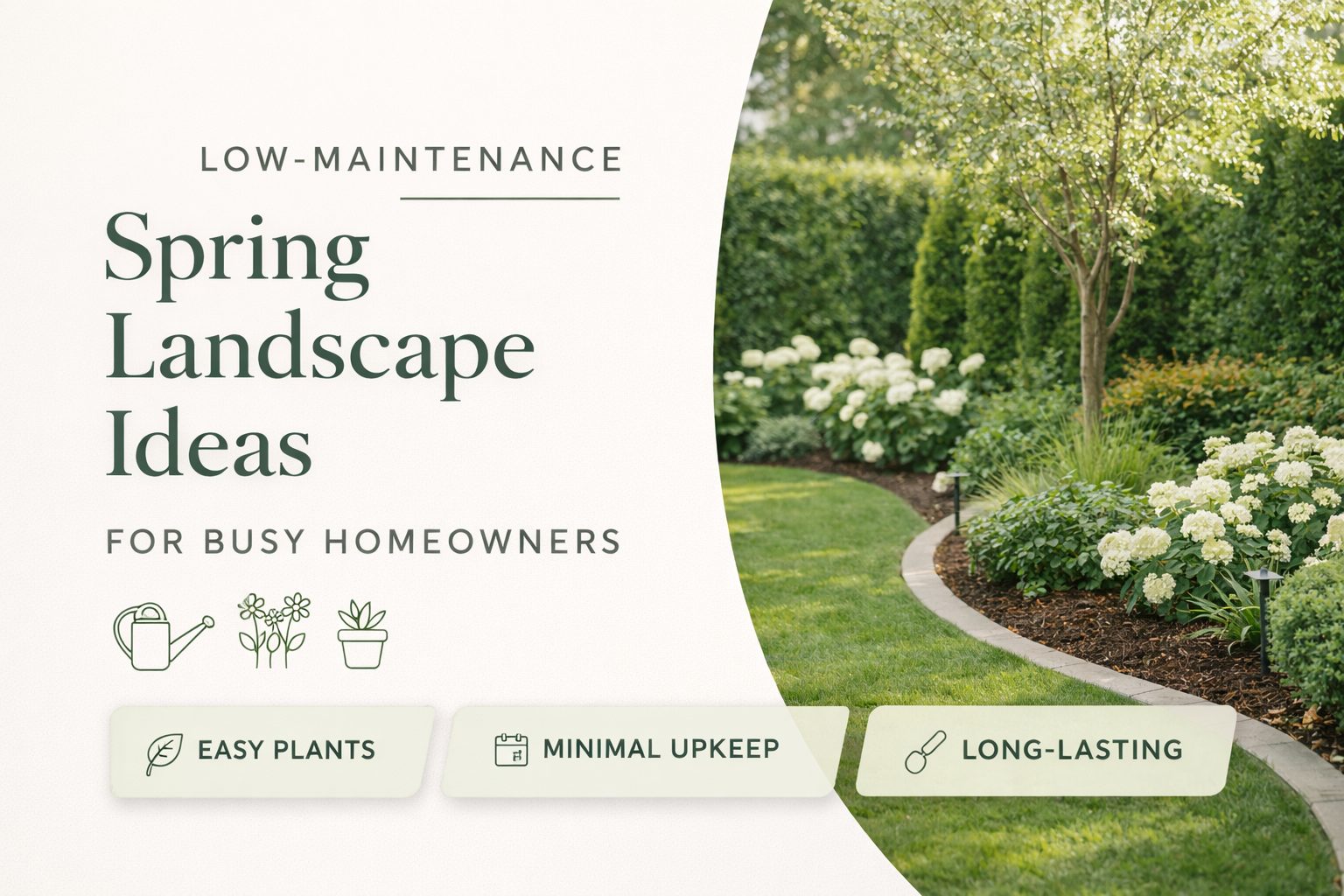
Spring is when many homeowners want their yard to look fresh again, but not everyone has time for weekly planting, trimming, feeding, and constant cleanup. A low-maintenance spring landscape is not about doing the bare minimum. It is about making smart choices early so the yard stays attractive with less effort through the rest of the season.
The best low-maintenance yards usually rely on a simple layout, durable plants, fewer problem areas, and materials that help control weeds and conserve moisture. Extension horticulture sources consistently note that mulch, well-chosen perennials, ground covers, and more efficient watering methods can all reduce routine upkeep when used properly.
If you are a busy homeowner, the goal should not be to create the most elaborate yard on the block. The goal should be to create a yard that still looks clean, healthy, and put together even when you do not have much time to work on it.
Start with a simpler landscape plan
Many spring landscaping problems begin with an overdesigned yard. Too many small beds, too many plant types, and too many disconnected features often lead to more watering, more edging, more replanting, and more confusion later.
A simpler layout is almost always easier to maintain. Larger planting beds are easier to mulch and weed than several tiny scattered ones. Repeating the same shrubs or flowering plants in a few sections also makes the yard feel cleaner and more intentional. This is one of the easiest ways to reduce maintenance without making the space feel plain.
For busy homeowners, simple usually wins. A clear bed line, a few dependable plant groupings, and one or two strong focal areas often look better than a yard packed with too many details.
Use mulch the right way
Mulch is one of the most effective low-maintenance tools in a spring landscape. It helps suppress weeds, conserve soil moisture, protect roots, and give beds a finished look. Extension guidance also warns against piling it too deeply. A common recommendation is to keep mulch around 2 to 3 inches deep and avoid “mulch volcanoes” around trees and shrubs.
That means mulch is doing two jobs at once. It improves the appearance of the yard and helps reduce repetitive work later.
Fresh mulch in spring can quickly improve:
- front foundation beds
- tree rings
- shrub borders
- mailbox plantings
- side-yard planting strips
Using one mulch colour throughout the landscape also helps the whole property feel more organized.
Choose plants that do not demand constant attention
A low-maintenance spring yard depends heavily on plant selection. Some plants look great for a few weeks but create ongoing work through staking, trimming, deadheading, dividing, or replacing. Others hold up much better with less attention.
Perennials are often a strong option because they return year after year, and many varieties require less work than seasonal annuals. Extension sources note that perennials can be relatively low maintenance, though not all are equally easy-care. Choosing sturdy, site-appropriate varieties matters more than simply choosing “perennials” in general.
Some commonly used low-maintenance spring and summer performers include:
- coreopsis
- salvia
- coneflower
- catmint
- daylilies
- black-eyed Susan
- lavender in the right conditions
The best approach is to avoid mixing too many plant personalities together. Pick a smaller group of reliable plants and repeat them across the yard. That creates a more polished look and usually makes care easier.
Add evergreen structure so the yard does not depend only on flowers
One reason some spring landscapes become high maintenance is that they rely too much on seasonal blooms. When flowers fade, the yard can quickly start looking empty or uneven. Evergreen shrubs help solve that problem by giving the yard shape, balance, and year-round structure.
A landscape with evergreen anchors usually needs fewer seasonal fixes because it already has a visual framework in place. Even when flowers are between bloom cycles, the yard still looks intentional.
Compact shrubs along the foundation, near the entry, or around key corners of the home can help hold the design together. This makes spring colour feel like an upgrade rather than the only thing carrying the whole landscape.
Reduce lawn where it creates extra work
A large lawn may look simple, but it often demands the most maintenance. Mowing, edging, watering, feeding, reseeding, and patching can take up more time than most homeowners expect.
One of the smartest low-maintenance ideas is to reduce grass in areas where it does not add much value. That could include narrow side strips, awkward corners, fence lines, slopes, or spots where turf always struggles.
Those areas can often be replaced with:
- mulched shrub beds
- gravel sections
- stepping-stone paths
- ornamental grasses
- ground covers
This reduces mowing and often makes the yard look more designed.
Use ground covers to fill space and reduce weed pressure
Bare soil is an invitation for weeds. Ground covers can help cover exposed areas, soften bed edges, and reduce maintenance once they are established. University sources describe ground covers as a kind of living mulch that can suppress weeds by competing for light, water, and space.
They can be especially useful:
- on slopes
- around trees
- in transition areas between beds and lawn
- in places where mowing is inconvenient
That said, ground covers still need some care while getting established. They are not instant zero-work solutions. But once they fill in, they can save time compared with keeping those same areas open, patchy, or grassy.
Water more efficiently, not more often
Watering is one of the biggest time drains in landscape care. A yard becomes easier to manage when plants are grouped by similar water needs and watered more precisely.
Drip irrigation is one of the best low-maintenance solutions for beds and borders. Extension sources note that drip systems apply water slowly at the root zone, waste less water than overhead sprinklers, and can use significantly less water in many situations. Iowa State notes drip systems can use 30 to 50 percent less water than sprinklers, while Utah State reports drip irrigation can be about 90 percent efficient.
For busy homeowners, that matters because it can reduce both water waste and the amount of time spent dragging hoses around the yard.
Focus on fewer, stronger design elements
A low-maintenance landscape often looks better because it is more disciplined. Instead of adding one of everything, choose a few elements that do their jobs well.
That might mean:
- one ornamental tree near the front yard
- one repeated evergreen shrub
- two or three perennial groups for seasonal colour
- one mulch type
- one path or border material
This gives the landscape rhythm without making it harder to maintain. It also makes future updates easier because you are working from a clear design instead of a collection of random additions.
Add containers only where they make the biggest impact
Containers can be useful in spring, but they should be used carefully in a low-maintenance yard. Too many pots can quickly become another watering chore.
Instead, place one or two larger planters near the entry, porch, patio, or garage area where they can provide visible seasonal colour. Larger containers usually dry out more slowly than smaller ones, which makes them more practical for busy homeowners.
This gives you that fresh spring look without committing the whole yard to high-care annual planting.
Common mistakes that make a spring landscape harder to maintain
A yard often becomes high maintenance because of a few early choices that seem small at first.
Common problems include:
- planting too many varieties
- using plants that outgrow the space fast
- leaving open soil between plants
- making too many tiny beds
- keeping lawn in hard-to-mow spots
- relying too heavily on short-season flowers
- skipping mulch and edging
Low-maintenance landscaping works best when the space is designed to stay tidy with less intervention.
How iScape can help you plan a low-maintenance yard
One reason homeowners end up with high-maintenance yards is that it is hard to picture spacing, flow, and bed size before anything is planted. That is where the iScape app can be useful.
According to iScape’s official site, the app lets users design in 3D with AR, and the company says it has nearly 4 million downloads and a 4.6 rating. Its App Store listing says the app is designed for both DIY homeowners and industry professionals, while its Google Play listing says it helps users plan outdoor spaces before work begins and organize project details more clearly.
For a low-maintenance spring project, iScape can help in a practical way:
- First, you can start with a photo of your actual yard instead of guessing from memory.
- Then, you can test simpler bed lines, mulch areas, shrubs, or walkway ideas before buying anything.
- You can also compare whether a design looks too crowded, too empty, or too lawn-heavy.
- That makes it easier to catch problems early and avoid building a yard that looks good at first but becomes difficult to care for later.
In simple terms, iScape helps homeowners plan before they spend. That is especially useful when your goal is not just a prettier yard, but a yard that stays manageable. Download iScape on the App Store or Google Play Store today and start designing today!
Final thoughts
Low-maintenance spring landscaping is really about reducing friction. The more your yard depends on constant replanting, trimming, watering, and correcting, the harder it becomes to enjoy.
Busy homeowners usually get better results by keeping the layout simple, using mulch correctly, choosing durable plants, reducing unnecessary lawn, filling problem areas with ground cover, and using smarter watering methods. Those choices create a yard that still looks fresh in spring without demanding too much of your time.
Download iScape on the App Store or Google Play Store today and start designing today!
Try a free trial today at iScape!